Specialty contractors — bid intelligence
Every bid.
Engineered, priced,
ready for review.
Opportunities into one pipeline. Deterministic geotechnical design, or subsurface-risk extraction for bid-only work, reviewed by your PE. A drafted estimate your estimator approves, priced against your own history as it builds. For helical pile, micropile, stone column, and drilled shaft contractors.
Consulting firms — Report Studio
Every report.
Drafted from logs,
ready for review.
Report Studio drafts the geotechnical report from your boring logs, lab data, and project documents. Every engineering value is computed by deterministic methods or tagged to its source, and export is blocked until your engineer of record confirms each mandatory-review field.
01 — For geotechnical consulting firms
Report Studio.
The AI doesn't compute your numbers.
Draft the full geotechnical report from your boring logs, lab data, and project documents — so your engineer of record reviews instead of re-authoring.
Computed, not generated
Allowable bearing pressure, settlement, lateral earth pressure, AASHTO 1993 pavement sections, and seismic site class come from deterministic, unit-tested calculators. The AI model reads your documents and writes the site narrative from your verified data; it computes no engineering value.
Tagged by source
Every value shows where it came from: calculated, document, live data (ASCE 7, USDA), boilerplate from your firm profile, or manual, so your reviewer knows what to check.
Your report format
Upload your standards documents and Word template once. An admin confirms the parsed firm profile, then every report exports on your template.
Export blocked until reviewed
Mandatory-review fields, such as the expansive-soil classification, must each be confirmed individually before a draft will export. It isn't a checkbox: the export itself refuses.
4.2 Subsurface conditions & recommendations
Shallow spread footings bearing in the stiff lean clay below approximately 4.5 ft may be proportioned for a net allowable bearing pressure of 3,000 psf, with total settlement estimated at less than 1.0 in. The site is classified as Seismic Site Class D in accordance with ASCE 7-22. Groundwater was not encountered within the explored depth. Minimum footing width is 16 in. Backfill compaction is set by the engineer at 95% of maximum dry density.
Expansive-soil classification: awaiting engineer confirmation.
The bid intelligence platform.
02 — For specialty geotechnical contractors
Five modules. One pipeline.
One data foundation.
What one module produces, the next starts from. The design informs the estimate, the estimate informs the price, and the outcome informs the next bid.
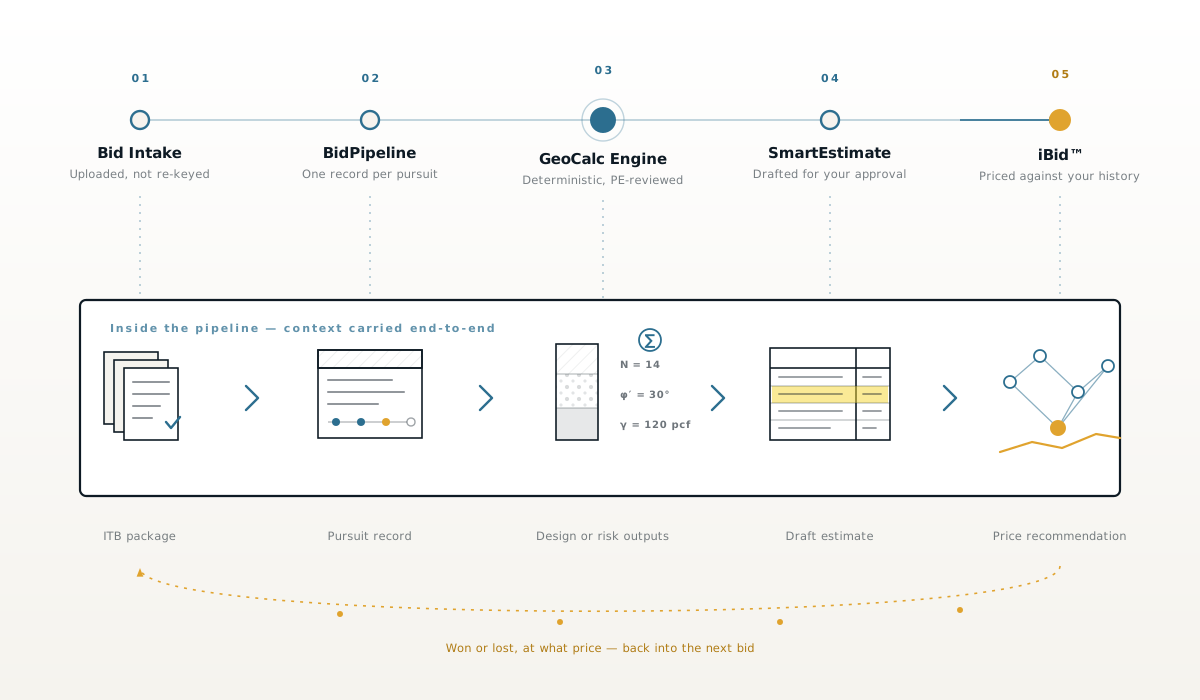
 Bid IntakeUpload a plan-room download, DOT package, or ITB email and it's ready for review — no re-keying. Platform connections are on the roadmap.
 BidPipelineApprove or reject for engineering review in one click, and record every outcome: won or lost, at what price.
 GeoCalc EngineReads the geotechnical report and runs manufacturer-table and FHWA calculations for your PE to review and approve. For drilled shaft: subsurface-risk extraction.
 SmartEstimateDrafts the cost breakdown from scope and design outputs, and drafts quote requests to regional vendors. Nothing goes out without your estimator's approval.
 iBid™Starts as analytics on your bid history and matures into line-item price recommendations as your data grows. Your intelligence, not ours.
 FoundationDataCoreTurns your past bid packages, reports, and cost records into a clean, structured foundation the other modules learn from.
03 — Why it holds
Three advantages.
One compounds.
Two hold up from your first bid. The third gets harder to copy with every bid you run.
Why CivilnexDeep domain expertise
From day oneFor helical piles, micropiles, and stone columns: deterministic calculations from manufacturer load tables and FHWA methods, the references your PE would cite. Your PE reviews and approves.
Your knowledge graph
Compounds over monthsA record linking soil conditions to the bid they drove, the outcome, and the lessons from the field. Yours alone. Thin on day one, sharper with every bid.
Context-aware flow
From day oneThe soil conditions GeoCalc extracts are in the estimate. The estimate's assumptions are in the price. The outcome goes back into the record. Nothing re-keyed between stages.
04 — Who it's for
Built for the people who do the work.
Contractor bid teams

Estimators
Aiming for 40–60% less prep time per bid.

Geotechnical PEs
Review and approve — don't rebuild.

Business Development
One view of every pursuit. No chasing for status.

Business Owners
More bids. Same overhead. Pricing that learns from your own jobs.
Consulting firms
See it on your own work.
Consulting firms
A 30-minute demo on a real project: boring logs in, drafted report out.